

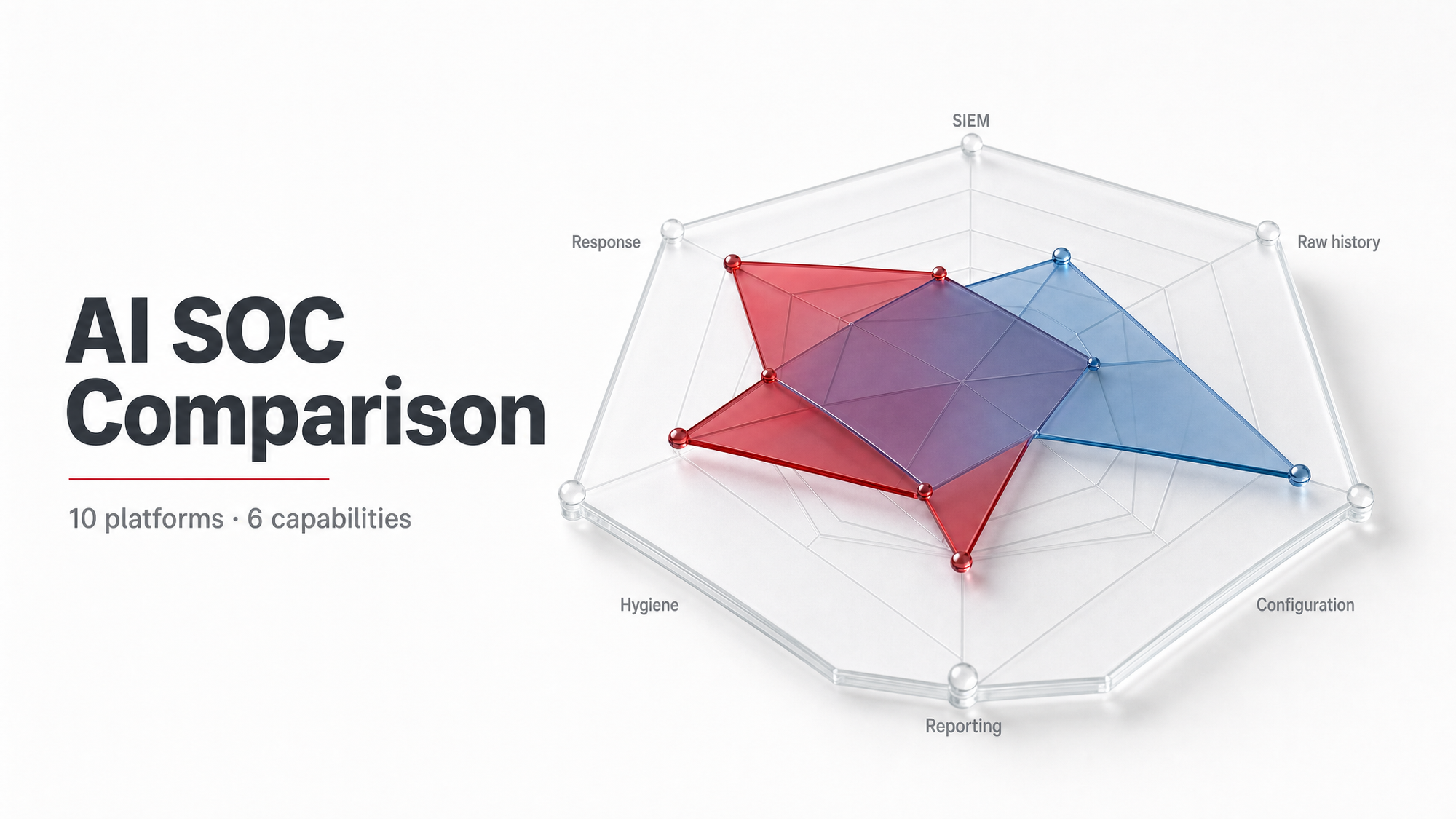
Every AI SOC vendor says the same thing. Their AI triages the alert, collects the evidence, explains its reasoning and saves your analysts time. If that's the whole pitch, every product looks the same, and you end up buying on brand.
Capability profile
Click a vendor to show or hide it. Unscored dimensions (? or P) plot at the center.
We wanted to see what's actually under the label. So we compared ten platforms: Fluency, Torq, TENEX, Exaforce, 7AI, Dropzone, Intezer, Qevlar, Prophet and Legion. We didn't score them on whether they do AI investigation, because they all claim to. We scored what surrounds it:
- SIEM foundation. Does the platform own the data, or does it sit on top of someone else's?
- Raw telemetry history. Can an investigation still reach the original events months later?
- Configuration intelligence. Does it understand the environment the activity happened in?
- Customer reporting. What does the customer actually receive?
- Hygiene and exposure. Does it do proactive posture work?
- Response automation. Who carries out the response, and under what controls?
The full white paper, with every score, evidence label and source, is at fluencysecurity.com/compare. Here's what we found and why it matters.
The AI is the baseline, not the differentiator
"Every alert investigated," "autonomous" and "reduced MTTR" sound like the same promise, but they can describe very different things. A verdict isn't a closed case. A closed case isn't containment. Containment isn't a verified recovery. You can't compare two vendors' numbers unless they started from the same alerts, needed the same evidence and stopped at the same point.
The same goes for the words around the AI. A saved case summary isn't a raw-event archive. An "organizational memory" isn't a configuration inventory. A generated incident narrative isn't a compliance assessment. Those gaps are what separate the products.
The scorecard
Each dimension is scored 1 to 3, where 3 is the broadest scope we could support from the material we reviewed. A 3 isn't three times better than a 1. It means broader documented scope on that one question.
AI SOC scorecard: six dimensions, scored 1 to 3, sorted by total
| Company | SIEM | Raw history | Configuration | Reporting | Hygiene / exposure | Response | Total |
|---|---|---|---|---|---|---|---|
| Exaforce | 3 | 3 | 3 | 2 | 2 | 3 | 16/ 18 |
| Fluency | 3 | 3 | 3 | 3 | 2 | 1 | 15/ 18 |
| 7AI | 3 | 2 | 2 | 1 | 2 | 3 | 13/ 18 |
| Torq | 1 | 1 | 3 | 2 | 2 | 3 | 12/ 18 |
| Dropzone | 1 | 1 | 1 | 1 | 1 | 2 | 7/ 18 |
| Intezer | 1 | 1 | 2 | 1 | ? | 2 | 7/ 18 |
| TENEX | 1 | 1 | ? | 1 | 1 | 2 | 6/ 18 |
| Prophet | 1 | 1 | 1 | 1 | ? | 2 | 6/ 18 |
| Legion | 1 | 1 | 1 | 1 | ? | 2 | 6/ 18 |
| Qevlar | 1 | 1 | 1 | 1 | P | ? | 4/ 18 |
? = not enough evidence to score. P = preview feature, not scored. Both count as 0 in the total, so a total is the sum of the scored dimensions out of a possible 18.
Who owns the data?
This is the biggest split in the market. Fluency, Exaforce and 7AI describe their own collection, normalization, search, detection and storage. Most of the others are investigation layers that run on top of your existing SIEM and security tools.
An overlay can be a good choice, especially if you already have a SIEM you're happy with. But it changes your dependencies. The overlay is only as good as the system underneath it, and that system has to stay available, affordable and searchable.
Can you still reach the evidence later?
Breaches are often found weeks or months after they start. When that happens, you need the raw events, not a summary of what the AI thought at the time.
Fluency keeps 12 months of history by default. Exaforce describes more than a year of queryable raw data. 7AI documents optional native storage, but how long it keeps data, and how much is included, isn't clear. For the rest, history depends on how long your connected tools retain data. If that telemetry expires, the investigation can't go back.
One caution: retention length isn't the same as included volume, search cost or price. We didn't treat any of those as free or unlimited.
Does it understand your environment?
The same login means something different on a contractor's laptop than on a domain admin's workstation. Context comes from identities, applications, devices, permissions and posture.
Fluency, Exaforce and Torq all describe broad, maintained configuration context. Fluency does it with property tables for identities, users, applications, Defender machines, vulnerabilities, AV health and Secure Score, plus audit and firewall changes. Torq and Exaforce describe graph-based models. We didn't treat a graph as automatically better than tables. What matters is field coverage, how fresh the data is, and whether you can reconstruct what the environment looked like at a given time. We weren't able to test any of those side by side.
What does the customer actually get?
This is the dimension MSSPs should care about most, and it's where Fluency stands apart. Customers don't just need incident narratives. They need hygiene reports, control posture, vulnerability findings and gap assessments, delivered on a schedule they can act on.
Fluency is the only platform we found with an identifiable multi-family assessment suite covering incident, hygiene, compliance and vulnerability outputs. Exaforce and Torq document custom or workflow-generated reports. Most of the others clearly support investigation reports, but not a broader set of customer deliverables. A dashboard or a certification badge isn't a report suite.
Who carries out the response?
Exaforce, 7AI and Torq document the broadest response automation: cross-tool actions, configurable workflows, approval gates and audit trails. Several others document narrower containment such as disabling accounts or blocking IPs.
Fluency scores a 1 here, and its on our roadmap to address this. Our current product delivers findings and recommendations for the MSSP to carry out. Many MSSPs want it that way, because the response is their service and their responsibility. If you want the platform itself to contain threats across your tools, Exaforce, 7AI and Torq describe more of that today.
How we scored, and what we didn't prove
We want to be clear about the limits of this comparison, because a comparison that hides its limits is just marketing.
- It's based on published material. We used vendor product pages, technical docs and workflow documentation available as of October 1, 2026. Every vendor's statements are treated as their claims, not as validated facts.
- Fluency had more evidence. We included owner confirmations and internal documentation for Fluency. That makes our own scores more specific, but it's also an asymmetry, and we've labeled it as one.
- No live benchmark. We didn't run the same workload through every product. Nothing here ranks detection accuracy, false negatives, investigation correctness, MTTR or total cost.
- Missing isn't absent. If a vendor doesn't describe a capability, we scored it as unknown, not as missing. Preview features got no credit.
- There's no overall winner. We didn't add up scores or crown a winner by radar-chart area. The six dimensions answer six different questions.
- Pages change, and we may have missed something. If you're one of these vendors and we got something wrong, send us the source and we'll update it.
Choose based on the gap you need to close
There isn't a single best AI SOC. There's the right one for the gap you need to close:
- Need a data foundation and long history? Look at platforms that own the SIEM and the archive.
- Already have a SIEM you like? An investigation overlay may be all you need.
- Need to deliver posture, compliance and hygiene reports to customers? Look at the reporting suite, not just the incident summaries.
- Need the platform to contain threats on its own? Look at documented response breadth and its approval controls.
The same chart can lead two buyers to different, correct decisions. What matters is knowing which question you're asking before the demo starts.
Read the full comparison, including every score's evidence and all 22 sources: fluencysecurity.com/compare