

Investigate
What happened—and what needs attention?
Follow a prioritized case through its timeline and source evidence. Ask about related behavior, missing context, and the next action to consider.
Why headless SIEM
Focus on the question you need answered—not how to operate the tool.
Fluency puts the SIEM’s information and operational capabilities within reach of Claude and Codex. Ask in your own words, follow the evidence, and explore what the answer means for your next decision. Your question can shape the analysis instead of having to fit a predefined screen.
That is what gets unleashed: the value of the data, the tools, and the expertise already inside your SIEM.
A conversation that can go further
A chart can show a change. Analysis explains the change, its significance, and what to consider next. Fluency helps you move from retrieving information to an articulated answer you can question, refine, and use to make a decision.
Investigate
Follow a prioritized case through its timeline and source evidence. Ask about related behavior, missing context, and the next action to consider.
Understand
Review coverage, source health, throughput, usage, and billing. Compare environments or periods to understand what changed and why it matters.
Plan
Forecast capacity and cost with explicit assumptions. Review certification evidence and process gaps, then prioritize improvements with your team.
The SIEM foundation
Fluency is built to excel at investigation. It organizes security activity before AI spends tokens on it, giving analysts and swarm workflows the correlated context needed to reach defensible closure efficiently.
User and entity behavior analytics (UEBA) and correlation connect identity, endpoint, email, and cloud activity to reveal changes that deserve attention.
Clustering brings related signals into meaningful cases, reducing the number of separate alerts an analyst needs to investigate.
Specialized AI work can follow the evidence in parallel, while risk scores, timelines, and source records keep the conclusion focused and reviewable.
What makes the conversation useful
An AI assistant embedded in a fixed interface can be limited to the questions, data, and actions that interface exposes. Fluency’s headless approach makes its capabilities available through MCP so your AI client can work across the information and processes needed to answer your question. Access remains governed by your permissions and customer scope.
Fluency retains security events and resource information, including configurations, vulnerability data, and system posture. Agents can use relevant information to understand the environment as well as what happened in it.
The interface has always helped people follow processes and understand the product. Fluency makes operational capabilities available as tools the AI can use, so it can carry out analysis across the system on your behalf.
Fluency’s MCP server introduces its capabilities and supplies relevant operational instructions into the agent’s context window. This context windowing helps the agent discover the tools, understand how to use them, and interpret their results.
Compare an unfinished month
You should not need to wait until the month ends to ask. Fluency can analyze the month so far, project the remainder from available trends, and compare that forecast with last month’s actual results.
The answer explains what changed and what it could mean for capacity, cost, or the team’s priorities. Actual results and projections stay distinct, with assumptions and evidence gaps visible.
From question to decision
Making information accessible does not mean sending every event to an AI model. Fluency’s correlation, behavioral analytics, clustering, and risk scoring organize the evidence first. The agent can then use the relevant context and tools to investigate and explain meaningful activity.
The goal is to align token usage with useful results while giving you room to articulate the problem and pursue the next question.
How Unbounded works
Ask in your AI clientChatGPT, Claude, and others.
Teach the agent FluencyMCP supplies the operating knowledge.
Analyze, forecast, compareGet useful work grounded in evidence.
Evidence and certification readiness
Fluency analyzes available security evidence and documented processes to help teams assess readiness, identify gaps, and prioritize the work needed to close them.
Distinguish controls supported by evidence from those partially supported or not yet demonstrated. Keep the basis and limits of each finding visible.
Identify missing telemetry, incomplete evidence, and process gaps. Turn the assessment into a prioritized remediation plan that teams can review.
Use the operational analysis alongside platforms such as Vanta and Drata. Fluency supports certification readiness; certification decisions remain with the assessor.
Inside Fluency Companion
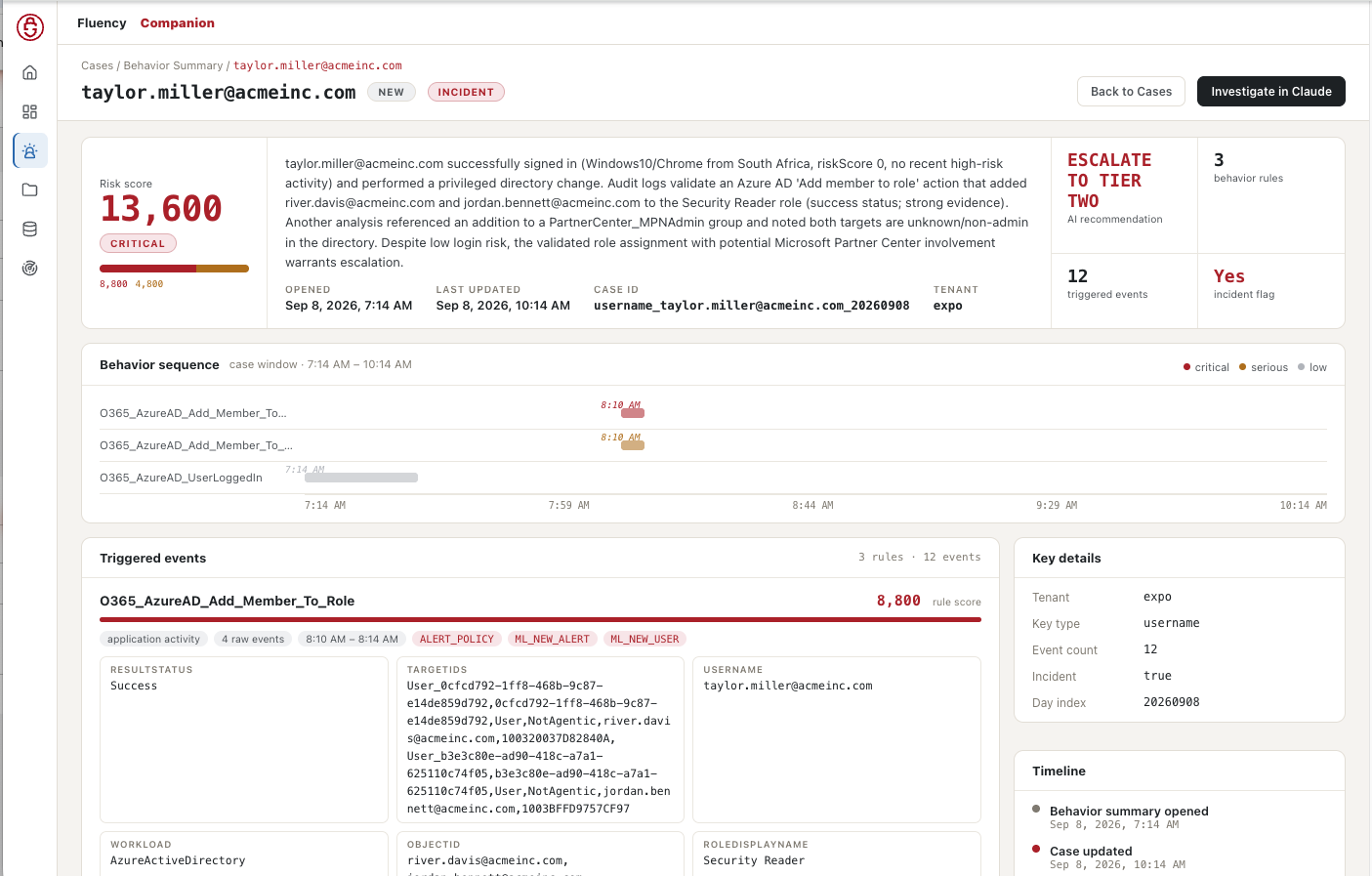
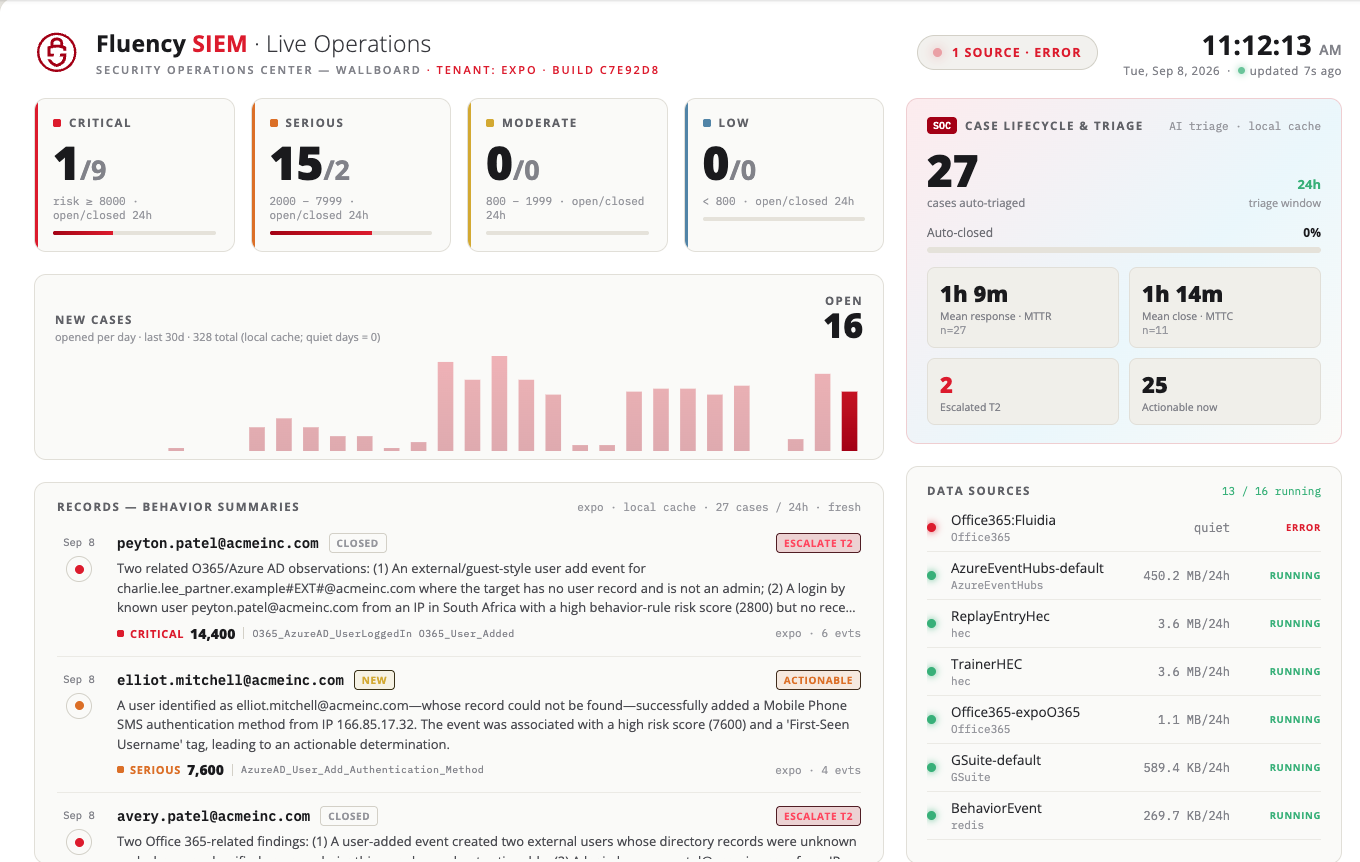
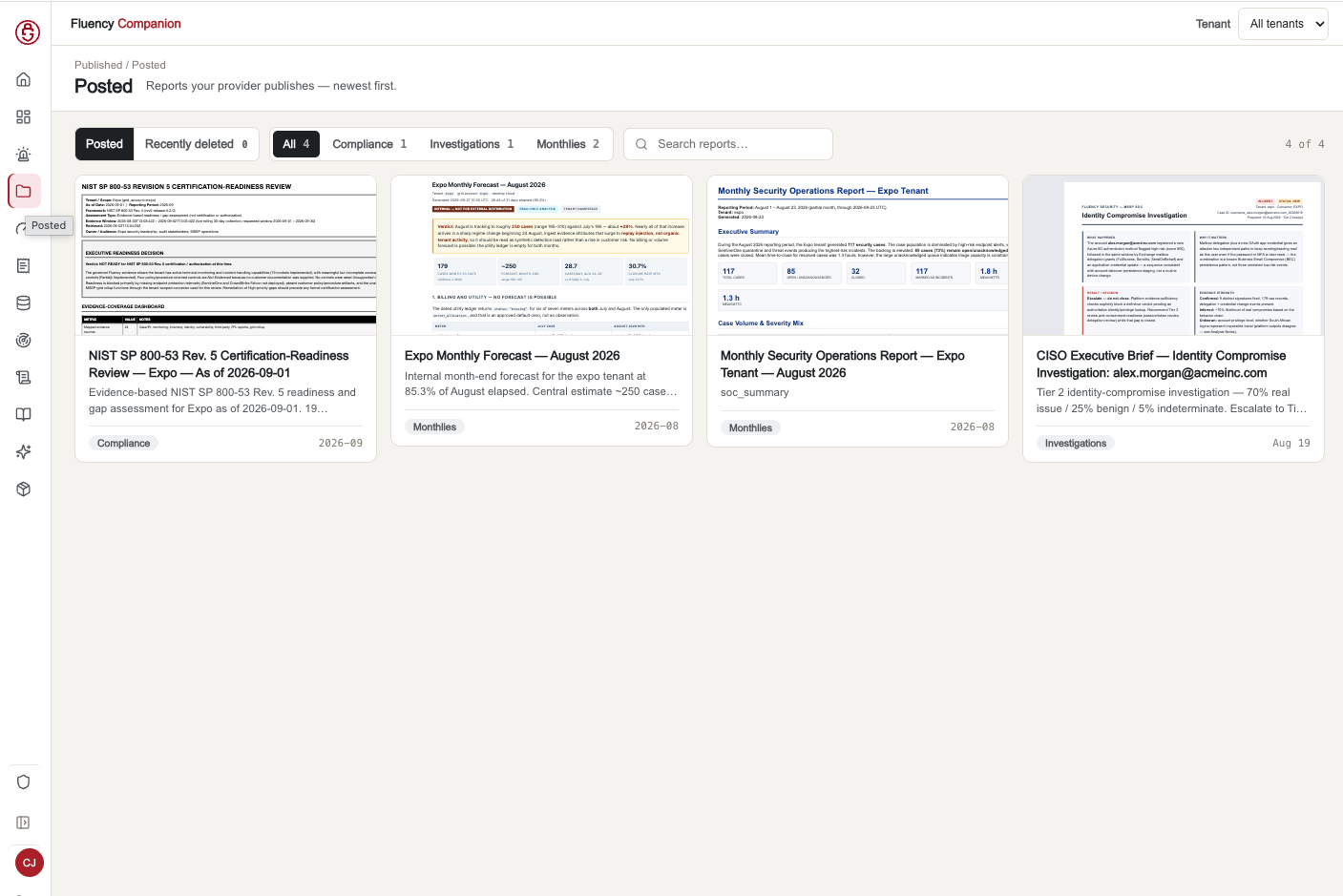
Companion brings correlated evidence, behavioral context, risk, and the next action into one working view. The same governed interface supports health reviews, certification evidence, weakness analysis, reporting, and operating plans without rebuilding the context.
Product screenshots use the Expo demonstration tenant with synthetic identities and intentionally unhealthy posture.
The company behind the product
Fluency combines its SIEM with hands-on deployment and ongoing support. We help customers overcome integration obstacles, establish useful workflows, and build operational capability.
Agree on the first sources, access requirements, and questions to answer. Verify data flow and usable results as onboarding progresses.
For MSSPs, multi-tenant workflows support customer onboarding, health reviews, investigations, and reporting within the appropriate customer scope.
Work with a team that understands the product and the operational obstacles. Fluency was recognized for Best Support in G2’s Fall 2026 reports.
Tell us what you want to understand. Leave your details above and our team will contact you about Fluency’s headless capabilities.